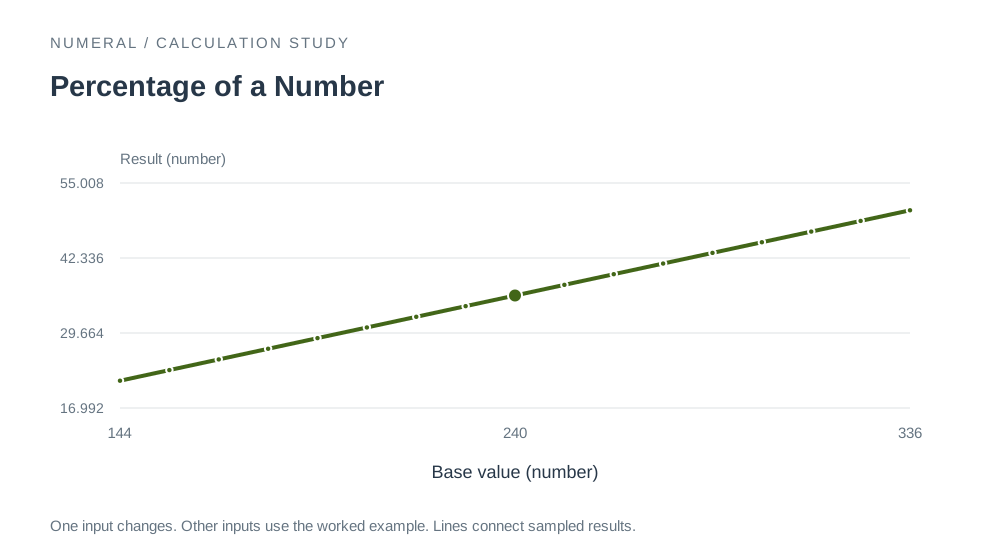
Percentages · 3 min read
Percentage of a Number: the method, worked through
A percentage describes a share of a chosen base.
A practical desk for everyday arithmetic, probability and descriptive statistics. Start with a question; leave with the method.
Percentages · 2 inputs
A percentage describes a share of a chosen base.
Open calculator ↗Percentage change measures movement relative to the starting value.
Open calculator ↗When neither observation is a natural baseline, the arithmetic average gives a symmetric denominator.
Open calculator ↗Recover an original quantity after a known proportional increase.
Open calculator ↗A discount is a reduction from the original amount.
Open calculator ↗Successive percentage changes compound because the second acts on an already changed base.
Open calculator ↗Express a measured part as a share of a reference total.
Open calculator ↗A percentage point gap subtracts two already expressed percentages.
Open calculator ↗Weighted averages give observations influence in proportion to their weights.
Open calculator ↗The arithmetic mean balances three observations equally.
Open calculator ↗The median is the middle observation in sorted order.
Open calculator ↗The geometric mean averages positive multiplicative factors.
Open calculator ↗The harmonic mean handles rates applied to equal quantities, such as equal distances traveled at two speeds.
Open calculator ↗Variance measures the spread around the mean in squared units.
Open calculator ↗Sample standard deviation expresses dispersion in the original measurement units.
Open calculator ↗Population standard deviation describes the spread of a complete three-observation set.
Open calculator ↗A z score expresses a distance from the mean in standard deviation units.
Open calculator ↗Standard error describes the sampling variability of a mean under independent sampling.
Open calculator ↗The coefficient of variation describes dispersion relative to a positive mean.
Open calculator ↗The range is the full span between the smallest and largest observations.
Open calculator ↗Root mean square summarizes the magnitude of signed observations without allowing positive and negative signs to cancel.
Open calculator ↗Linear interpolation estimates a value on the straight line through two known points.
Open calculator ↗Slope compares vertical change with horizontal change.
Open calculator ↗Solve an equation of the form ax + b = c by undoing addition and multiplication in reverse order.
Open calculator ↗The discriminant indicates the real-root structure of a quadratic equation.
Open calculator ↗This tool evaluates the plus branch of the quadratic formula for a real-coefficient equation.
Open calculator ↗An arithmetic sequence adds the same difference at every step.
Open calculator ↗An arithmetic series adds a finite run of equally spaced terms.
Open calculator ↗A geometric sequence multiplies by a constant ratio at every step.
Open calculator ↗The finite geometric sum combines a series of repeatedly scaled quantities.
Open calculator ↗Factorial counts orderings of distinct objects.
Open calculator ↗Permutations count ordered selections without replacement.
Open calculator ↗Combinations count unordered selections without replacement.
Open calculator ↗A binomial model describes a fixed number of independent trials with the same success probability on each trial.
Open calculator ↗Multiply two probabilities to find their joint occurrence only when the events are independent.
Open calculator ↗The complement of no successes gives the chance of at least one success.
Open calculator ↗An event and its complement cover all outcomes without overlap.
Open calculator ↗An expected value is a probability-weighted average across two exhaustive outcomes.
Open calculator ↗Odds in favor compare favorable outcomes to unfavorable ones.
Open calculator ↗A continuous uniform distribution allocates probability in proportion to interval length.
Open calculator ↗A logarithm asks which exponent raises the base to the target value.
Open calculator ↗An nth root reverses raising a nonnegative value to an integer power.
Open calculator ↗A proportional scale preserves a ratio while changing the reference quantity.
Open calculator ↗Direct proportion keeps y divided by x constant.
Open calculator ↗Inverse proportion keeps the product of two quantities constant.
Open calculator ↗The remainder is what remains after fitting the largest whole number of divisor-sized groups into a nonnegative dividend.
Open calculator ↗The greatest common divisor identifies the largest exact shared grouping.
Open calculator ↗The least common multiple gives the smallest positive count divisible by both inputs.
Open calculator ↗Distance on a line removes direction and reports the separation of two signed positions.
Open calculator ↗The midpoint lies equally far from two positions on a straight number line.
Open calculator ↗No matching tools. Try a shorter search or choose all categories.
A percentage describes a share of a chosen base.
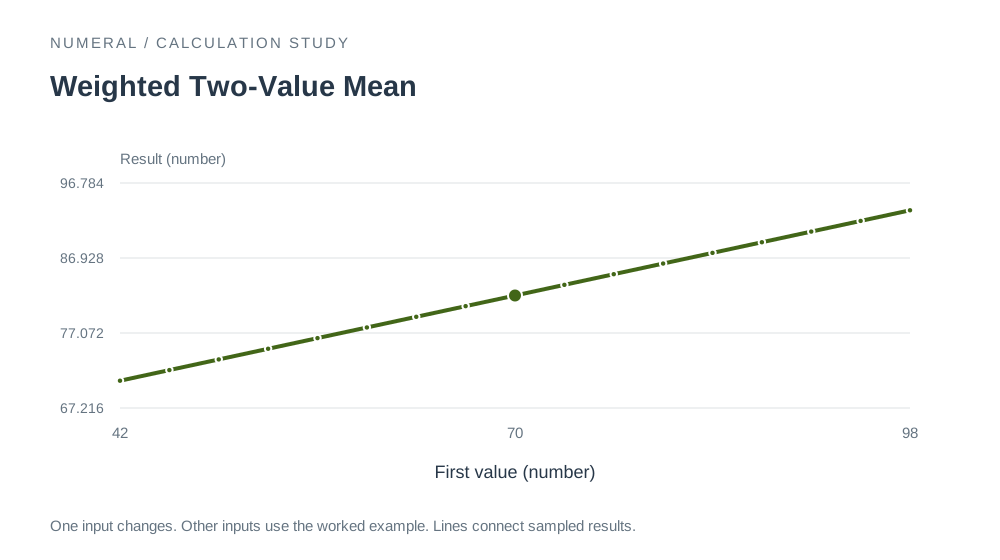
Weighted averages give observations influence in proportion to their weights.
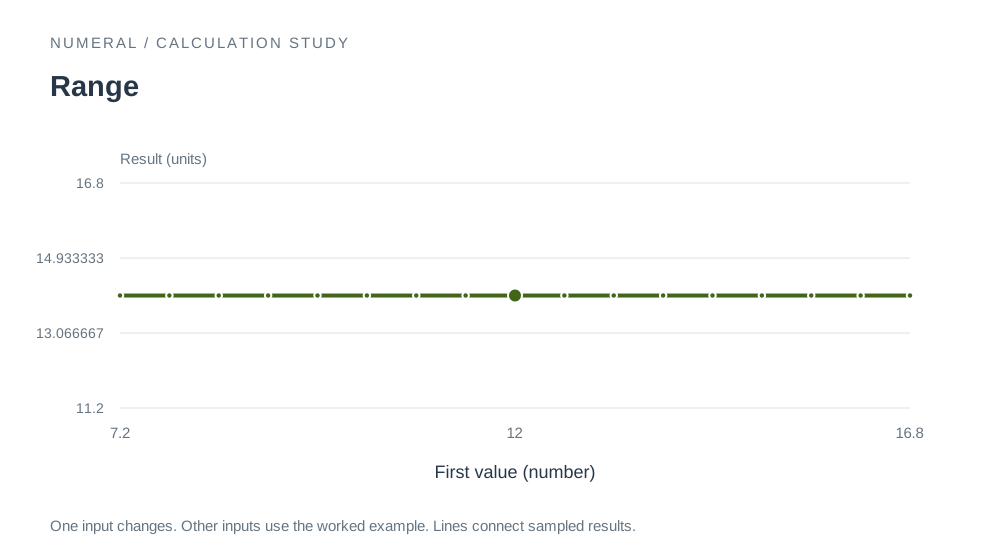
The range is the full span between the smallest and largest observations.